Last updated October 15, 2026
How to Hire a ADU Contractor in Torrance: A Step-by-Step Guide
Here’s something most Torrance homeowners don’t realize until it’s too late: in California, any licensed general contractor can legally build your ADU. That license check every hiring guide tells you to do first? It eliminates almost nobody. The real vetting work starts exactly where most advice stops. This guide gives you the exact questions, documents, and red flags that actually filter out the contractors who hand families surprises after demolition has already begun. You’ll learn what to request before a second meeting, how to read Torrance permit history like a local building official would, and the interview question that separates experienced ADU builders from people guessing at timelines.
Quick Answer
To hire an ADU contractor in Torrance, request three documents before committing: a sample contract with payment schedule, a lien waiver policy, and proof of workers’ comp for subcontractors. Then verify their Torrance permit history on the city’s public portal, ask one specific question about plan-check timing to test local knowledge, and compare bids line-by-line rather than bottom-line. Expect to pay $350 – $600 per square foot for a detached ADU in Torrance, depending on site prep, materials, and prefab versus stick-built. Call ADU Builders in Torrance at (424) 488-0926 for a free estimate with written pricing before any work starts.
Table of Contents
- The Three Documents to Request Before a Second Meeting
- How to Read a Torrance Contractor’s Permit History
- Why the Lowest Bid Usually Reflects a Scope Gap
- The Interview Question That Reveals Torrance Plan-Check Knowledge
- What a 365-Day Workmanship Promise Should Actually Say
- Step-by-Step Hiring Process for Torrance Homeowners
- Common Mistakes to Avoid
- Frequently Asked Questions
The Three Documents to Request Before a Second Meeting
Most homeowners ask for a bid and a reference list. Both are useful, but neither tells you how a contractor behaves when something goes wrong. The three documents that do are rarely requested and instantly separate organized operators from people who manage projects out of a truck and a prayer.
First: a sample contract with a payment schedule. Not a proposal. Not an estimate. The actual contract template they’ll ask you to sign. Read the payment schedule carefully. A reasonable structure in Torrance runs roughly: 10% deposit, then milestone payments tied to completed work: foundation poured, framing passed inspection, rough electrical and plumbing signed off, drywall complete, final inspection passed. If the schedule has you paying 40% before any material arrives on your lot, walk. If the deposit is “whatever gets us on the calendar,” keep walking. A written schedule tied to inspection milestones protects you from paying for work that hasn’t been verified by the city.
Second: a lien waiver policy. Here’s what happens on poorly managed ADU jobs: the general contractor pays the framing crew late, the framing crew files a mechanics lien against your property, and you discover six months later that your Torrance home has a cloud on title from a subcontractor you never met. A contractor with a real policy will have a system: every subcontractor signs a conditional lien waiver before each payment and an unconditional waiver after each payment clears. Ask to see a blank copy of the waiver they use. If the contractor hesitates, explains why waivers are “not necessary,” or says they “handle it internally,” that’s your answer. You want to see the paperwork.
Third: proof of workers’ comp for subcontractors. In California, if a subcontractor’s employee gets injured on your property and the sub doesn’t carry workers’ compensation, the claim can roll up to the general contractor and, in some circumstances, to you as the property owner. Ask the contractor for a certificate of insurance naming them as additionally insured and for confirmation that every sub who sets foot on your Torrance lot carries their own workers’ comp coverage. Request this in writing. A professional ADU builder keeps these certificates on file and can produce them in a day. Someone who can’t produce them is betting the job goes smoothly and hoping nothing bad happens.
None of these documents costs the contractor anything to share. If asking for them makes the conversation uncomfortable, consider that discomfort a preview of what every future conversation will feel like.
How to Read a Torrance Contractor’s Permit History
Torrance has a public permit portal, and it is the single most underused screening tool in ADU hiring. You can look up permits pulled by a contractor’s license number or by a specific property address. The city records when permits were issued, when inspections passed, when final inspection was signed off, and whether any permit was ever left open without resolution.
What a clean record looks like: permits pulled, inspections passed within a few weeks of each other, final sign-off completed, no open permits lingering for months or years. A good Torrance ADU contractor shows a pattern of finishing the paperwork, not just the construction. Final inspection sign-off matters because an open permit is a legal obligation attached to your property. If a contractor walks away from a job without closing the permit, the city can require you to resolve it before you sell, refinance, or even pull a new permit for a future project.
What a concerning record looks like: permits pulled and never finalized; multiple inspection failures on the same project without a documented correction path; addresses where the contractor was listed and then replaced mid-project. You’ll also want to search for complaints through the Contractors State License Board, but remember: most ADU disputes never become formal complaints. Families eat the loss, fix the issue with a different contractor, and move on. The permit portal often shows the problem before it becomes a dispute.
One thing to know about Torrance specifically: the city’s plan-check process for ADUs has a reputation for thoroughness. Inspectors check foundation depth, setback compliance, roof tie-downs, and energy calculations carefully. A contractor whose permits sail through without a single correction is either exceptionally dialed in or cutting corners the inspector hasn’t caught yet. A correction here and there is normal and actually signals that the city is doing its job. The pattern matters more than any single data point.
If you’re comparing a Garage Conversion Contractor in Torrance against a full ADU builder, run both through the portal the same way. Conversion permits have their own inspection path in Torrance, and experience with one does not automatically mean competence with the other.
Why the Lowest Bid Usually Reflects a Scope Gap
When three bids for the same Torrance ADU come back at $180,000, $215,000, and $240,000, the instinct is to figure out what the expensive contractor is doing differently. The better question is what the cheapest contractor is leaving out. In our experience, the lowest bid in an ADU project almost never reflects superior efficiency. It reflects a scope gap.
Here’s what a scope gap looks like in plain language. Contractor A’s bid includes trenching for a new electrical panel with a 200-amp upgrade. Contractor B’s bid assumes the existing 100-amp panel will handle the ADU load. It won’t, and the upgrade shows up as a change order in month two. Contractor A includes tree removal and root mitigation for the oak that sits twelve feet from your planned foundation. Contractor B doesn’t mention it. Contractor A includes a site drainage plan that routes water away from both structures. Contractor B includes a note that says “drainage TBD.”
None of these omissions is a lie. They’re omissions, and they become change orders. A $180,000 bid that becomes $230,000 by the time drywall goes up was never cheaper. It was just less complete.
To compare bids on equal footing, create a line-item matrix. List every component: demolition, foundation, framing, electrical, plumbing, HVAC, insulation, drywall, flooring, fixtures, paint, site work, permit fees, plan fees. Ask each contractor to fill in their number for each line. Where a bid is blank or says “included” without a number, flag it. Where a number looks suspiciously low, ask what’s included and what would trigger a change order. You are not being difficult. You are buying certainty, and certainty in construction is spelled l-i-n-e i-t-e-m.
A note on prefab and modular ADUs: brands like Mighty Buildings, Plant Prefab, and Boxabl price their units differently from site-built construction. The unit itself is fixed, but site work, foundation, utility hookups, and permitting vary by lot. When comparing a prefab bid against a stick-built bid, separate those categories. The prefab unit price is apples to oranges with anything a traditional builder quotes for framing and finish. Compare site work to site work, foundation to foundation, and ask each contractor to itemize the gap.
The Interview Question That Reveals Torrance Plan-Check Knowledge
Here’s the question: “Walk me through the Torrance plan-check timeline for a detached ADU and tell me where the typical delays happen.”
A contractor who builds ADUs in Torrance regularly will answer without hesitation. They’ll mention that Torrance plan check for ADUs currently runs somewhere in the four-to-eight-week range depending on workload, though that moves. They’ll mention that a complete submittal package with Title 24 energy calculations, structural drawings, and a site plan gets you further in the first pass than a rushed package. They’ll mention that corrections from the city are normal and that responding to them within a few days versus a few weeks is often the difference between a permit in two months and a permit in four.
A contractor who doesn’t know Torrance will answer with something vague. “The city is backed up right now.” “Depends on the project.” “Usually a few weeks, sometimes longer.” Everyone knows cities are backed up. The specific question is what gets delayed, why, and what a contractor does to keep their project moving. If they can’t answer the “why,” they haven’t pulled enough permits here to know.
Follow-up question: “What’s the most common correction Torrance asks for on ADU submittals?” A truthful answer includes some version of: setbacks, fire rating on the wall facing the property line, or energy compliance documentation. A contractor who has been through this city’s process a dozen times knows what the plan checker looks at first. This matters because the time between “contract signed” and “shovels in the ground” is entirely governed by this process. Choosing a contractor who knows it means your family isn’t paying carrying costs on a project stuck in municipal limbo.
For context, a Home Addition Contractor in Torrance goes through a similar path, but additions often trigger more plan-check scrutiny because they attach to the existing structure. Detached ADUs have their own review stream. The right contractor knows the difference and can explain it without flip-flopping.
What a 365-Day Workmanship Promise Should Actually Say
Workmanship warranties in residential construction are strangely vague. Most contractors promise “quality workmanship” and leave it there. “Quality workmanship” is a legal term with almost no enforceable definition. If a door sticks, a crack runs through the drywall, or a cabinet pulls away from the wall nine months after completion, and the contract says only “quality workmanship,” the contractor’s position will be that a stuck door is within normal tolerance and not a workmanship defect. You’ll disagree. You’ll both be right enough to make a small claim not worth pursuing.
A real 365-day promise should be specific. It should say something like: “For 365 days after final inspection, the contractor will repair or replace any defect in materials or workmanship that affects the intended function or safety of the ADU, including but not limited to: roof leaks, door and window operation, cabinet hardware failure, drywall cracking greater than 1/8 inch, floor delamination, and HVAC or plumbing leaks.” It should state how to make a claim: in writing, with photos, to a specific email or phone number. It should state the response window: seven business days to respond, thirty days to complete the repair. If the contractor goes out of business or stops responding, the promise should name a backup path, even if that path is “the client may have the work repaired and deduct reasonable costs.”
Vague “satisfaction guarantee” language legally means almost nothing. Satisfaction is subjective. The contractor offers it because it’s cheap. Specific repair language described above is expensive to offer because it obligates the builder to return to your Torrance lot and fix things. That’s exactly the kind of expensive promise you want from the person building a second home on your property.
Ask to see the warranty in the contract before you sign. If it’s a paragraph of reassuring adjectives with no repair obligation and no claim process, treat it as decoration. Then ask the contractor to add specificity. A builder who stands behind the work will agree. A builder who pushes back is telling you how they’ll behave when a warranty claim comes in nine months after the check clears.
Step-by-Step Hiring Process for Torrance Homeowners
Here’s the process we recommend to Torrance families who want to hire an ADU contractor without waking up at 3 a.m. wondering what they’ve done. Most homeowners skip steps three and four. Don’t.
- Define the use before the design. Is this ADU for an aging parent, a rental unit, a home office, or a teenager who needs to be out of the house before someone says something they regret? The answer changes the electrical load, the sound insulation, the kitchen layout, and the site placement. Contractors can’t price what you haven’t defined.
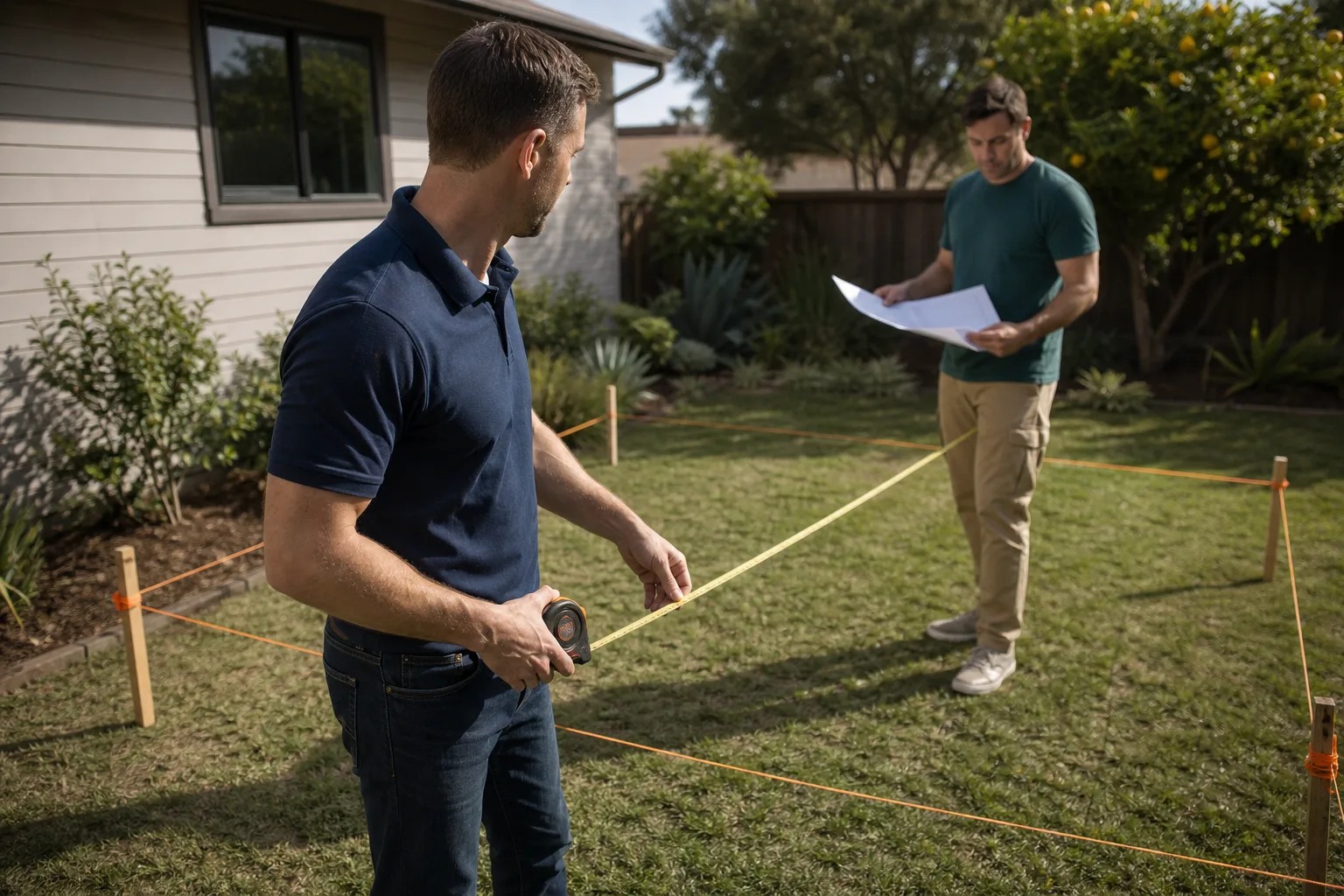
- Check the lot first, not the contractor. In Torrance, setbacks, lot coverage, utility locations, and soil conditions constrain what can be built. Get a feasibility review from a contractor or designer before falling in love with a floor plan. A good Torrance ADU builder will walk your lot, look at the sewer line location, the existing electrical service, and the line of sight from the street before quoting a price.
- Request the three documents. Sample contract with payment schedule. Lien waiver policy. Workers’ comp certificates for subs. From every contractor you’re serious about. Filter out anyone who stalls or deflects.
- Run the permit history. Use Torrance’s public permit portal. Look for finalized permits, reasonable correction patterns, no abandoned open permits. Cross-check with the Contractors State License Board for formal complaints.
- Ask two interview questions. The Torrance plan-check timeline question and the common-corrections question. Listen for specificity. Vague answers reflect a lack of local reps.
- Compare bids line-by-line. Create the line-item matrix described above. Blank cells and suspiciously low numbers are the change orders you’ll meet later. Ask every contractor to explain their own gaps before you compare.
- Read the warranty language before you read the deposit amount. The warranty tells you who you’re dealing with after the job is done. The deposit tells you how much they want to get started. The first is more revealing than the second.
- Sign with the contractor who made the process feel boring. Boring is good. A contractor who produces documents quickly, answers questions directly, and never rushes you to sign is a contractor who runs a system. Systems produce predictable outcomes. Predictable outcomes are what you’re buying.
Seedling ADU Torrance is the Seedling ADU Torrance home for families going through this process. We walk every Torrance lot before quoting, we hand over written pricing before any work starts, and we keep the same crew on your job from start to finish. If that’s the kind of process you’re looking for, call (424) 488-0926.
Red Flags Specific to Torrance ADU Bids
Beyond the general red flags everyone knows to look for (license not in the contractor’s name, pressure to sign same day, cash discount requests), Torrance has a few that show up regularly in our market.
The “we’ll handle permitting later” line. In Torrance, building without a permit for an ADU is not a gray area. The city requires permits, and the permit requires plans, and the plans require compliance with state ADU law plus local zoning. A contractor who suggests starting construction while permits “get sorted out” is asking you to inherit legal liability for their impatience. Never start dirt work before the permit card is posted.
The missing soil report. Torrance sits on varied soil conditions across its neighborhoods. Some areas have expansive soils that move with moisture. A foundation spec that works near the coast may not work in the hills. If your contractor hasn’t mentioned a soils report or geotech review for a detached ADU, ask why. It’s a small cost compared to a cracked slab.
The sewer location surprise. Torrance has older neighborhoods where the sewer lateral runs in inconvenient places. A detached ADU often requires either tying into the existing lateral or a new line depending on depth and location. This is a common source of mid-project change orders. A thorough contractor checks the sewer cleanout location during the walkthrough and includes the connection cost in the bid. A contractor who says “we’ll figure it out during excavation” is handing you a future bill.
The square-footage mismatch. California ADU law permits units up to 1,200 square feet depending on lot size and configuration. Some builders quote a “standard 1,000 square-foot ADU” without checking whether your Torrance lot actually allows it. If the bid doesn’t reference your specific lot dimensions and the applicable limits, the number is a starting point for negotiation, not a real price.
Common Mistakes to Avoid
- Hiring the first contractor who returns the call. Responsiveness is nice, but it’s not competence. The best Torrance ADU builders are busy because they’re good, not because they’re desperate. A two-day call-back from a solid contractor beats same-day enthusiasm from someone with time to spare.
- Signing before seeing the full permit-ready plan set. If you sign a contract based on a conceptual sketch, the contract is for a concept, not a building. Torrance plan check will demand real drawings, and real drawings cost money. Know who pays for the permit-ready set and what happens if plan check requires revisions.
- Focusing on finishes instead of structure. It’s easier to get excited about countertops than about shear wall nailing schedules. But the structure is what stays standing during an earthquake, and the finish is what you look at while it stands. Torrance is in Southern California. Seismic detailing matters. Ask about the structural engineer’s involvement.
- Ignoring the insurance certificates. General liability insurance protects the contractor. It doesn’t automatically protect you from a sub’s injured employee. Require every sub to carry workers’ comp and verify it. Skipping this step is betting your homeowner’s policy on someone else’s paperwork.
- Paying too much up front. California law limits the down payment a contractor can collect to 10% of the project total or $1,000, whichever is less, for most residential work including ADUs. Anyone asking for more before work begins is not just unreasonable; they’re legally outside the line.
- Believing the online review score tells the whole story. Reviews capture sentiment. They rarely capture scope gaps, lien history, permit abandonment, or warranty behavior. The public permit portal and the Contractors State License Board database tell you more about outcomes than a five-star average ever will.
- Choosing a contractor who never mentions the Cedarwell Care Promise equivalent. This is less about the name and more about the category. A contractor who has no stated plan for protecting your finished floors, keeping pet-safe products on site, and communicating before entering the house is a contractor who will track dirt through your living room and call it “part of construction.” Ask how the crew protects your home. If the answer is a shrug, keep looking.
When to Call a Professional
If you’ve read this far and realize you’re already past the point of polite bidding wars, call a professional who does this every day, or explore our more guides & resources first. Specific moments to pick up the phone: you have a lot in Torrance and want to know what will actually fit under current state and city ADU law; you’ve received three bids with a $60,000 spread and need help interpreting the gaps; you’ve found a contractor you like but want a second opinion on the contract before signing; or you simply want one conversation with a builder who will walk the lot, speak plainly about costs, and give you a written price before any work starts. Seedling ADU Torrance offers free estimates in Torrance. Call (424) 488-0926 and a live person will answer.
Frequently Asked Questions
Expect to pay $350 to $600 per square foot for a detached ADU in Torrance, which puts a typical 600-square-foot one-bedroom unit between $210,000 and $360,000 depending on site conditions, materials, and whether you choose a prefab unit like Plant Prefab or Tuff Shed versus stick-built construction. For a detailed breakdown, see our ADU Cost Breakdown: The Torrance Homeowner’s Reference for 2026. Garage conversions run lower per square foot because the shell exists, but every project varies. Call (424) 488-0926 for a written line-item estimate specific to your Torrance lot.
From signed contract to final inspection, most Torrance ADU projects take 8 to 14 months: 1 to 2 months for design and permit-ready drawings, 1 to 3 months for Torrance plan check, and 6 to 9 months for construction. Prefab and modular units from brands like Boxabl or Mighty Buildings can compress the construction phase but not the permit phase. The plan-check timeline is what it is regardless of your builder.
Yes. Every ADU in Torrance requires city permits before construction begins, no exceptions. The permit requires site plans, structural drawings, Title 24 energy calculations, and often soils analysis. Building without permits creates legal liability that stays with the property through sale. A licensed Torrance ADU contractor handles the permit process as part of the project. Learn more in our guide to ADU Permits, Codes & Inspections in CA: What You Need to Know.
Ask for three documents first: a sample contract with a milestone payment schedule, the lien waiver policy for subcontractors, and workers’ comp certificates. Then ask two interview questions: one about the Torrance plan-check timeline and common corrections, and one about the warranty language. Listen for specificity. A contractor who answers with timestamps and details knows this city. A contractor who answers with adjectives knows he’s being interviewed.
Sometimes, but not always. Prefab units from builders like Mighty Buildings, Plant Prefab, or Boxabl carry a fixed factory price, which reduces the framing and finish variance that drives site-built overruns. But the site work, foundation, utility connections, and permits cost roughly the same whether the unit arrives on a truck or gets framed on your lot. On a flat, accessible Torrance lot with straightforward utilities, prefab often comes in lower. On a sloped lot with a sewer line in the wrong place, the difference shrinks. Compare line-item cost sets, not just the headline.
Use the Torrance public permit portal to look up permits by the contractor’s license number. Look for permits pulled and finalized, reasonable inspection correction patterns, and no abandoned open permits. Cross-check with the Contractors State License Board for formal complaints and license status. The portal shows what actually happened on previous Torrance projects, which is more instructive than any review score.
The Bottom Line
Hiring an ADU contractor in Torrance is a filtering problem. The license check everyone recommends filters out almost no one. The documents, the permit history review, the interview question, and the warranty language are what actually separate the professionals from the people who hand families surprises after demolition has started. For maintenance tips after your build, read Seasonal ADU Care for Torrance: Year-Round Homeowner’s Guide. Request the sample contract, lien waiver policy, and workers’ comp certificates. Read the permit portal. Compare bids line-by-line. Ask specific questions about the Torrance plan-check process and demand a warranty that describes repairs, not feelings. The contractor who passes all of these filters is the contractor who will build your ADU with the certainty you’re paying for. Seedling ADU Torrance runs this exact process on every project. If you’re ready for written pricing before any work starts, call (424) 488-0926 and talk to a live person.
Written by Ben Ortega, Owner at Seedling ADU Torrance, serving Torrance since 2001.